The shared method
Both disciplines arrive at the same conclusion from opposite ends: the absolute value of a reading is a poor signal and its rate of change is a good one.
In maintenance this is uncontroversial. Nobody sets a fixed vibration limit and waits for a machine to reach it; the practice is to trend a machine against itself and investigate when the trend bends. Two identical pumps have different normal vibration, and the same pump has different normal vibration in July than in January.
Hazard detection has been slower to accept the same argument, largely because a fixed threshold is easy to certify and easy to explain. But the underlying situation is identical: a gas element drifts as it ages, reads differently at 40% and 80% humidity, and differs from the identical element next to it. A limit low enough to be useful gives false alarms; a limit high enough to be quiet catches things late.
So both end up in the same place - a baseline per sensor per location, and a decision made on movement away from it.
Where the two jobs diverge
It would be convenient if one system served both without qualification. It does not, and the differences are worth being precise about.
- Deadline. Maintenance acts on a trend over weeks. A hazard is decided in seconds, and the decision has to be local, because a network outage cannot be allowed to postpone it.
- Cost of a false positive. A spurious maintenance alert costs an inspection. A spurious evacuation costs production and, repeated, costs the alarm its credibility - which is far more expensive than either.
- Cost of a false negative. A missed bearing costs a machine. A missed release costs something that cannot be bought back.
- Sampling. Bearing defect frequencies live in the kHz and need a spectrum. A gas release needs a few seconds of resolution across several channels at once. The same board can do both; the same sampling schedule cannot.
- Auditability. A maintenance model may be as opaque as it likes if it is useful. A safety decision has to be explainable line by line after the fact.
What one instrument can honestly do for both
The overlap is real and it is mostly in the sensing and the history, not in the decision.
One node on a machine that already carries thermal, vibration and acoustic channels for hazard reasons is producing exactly the data a condition-monitoring programme wants, at no extra hardware cost. A bearing housing running four degrees hotter than the same housing did last month, with vibration magnitude up a few percent, is a maintenance finding that fell out of a safety installation.
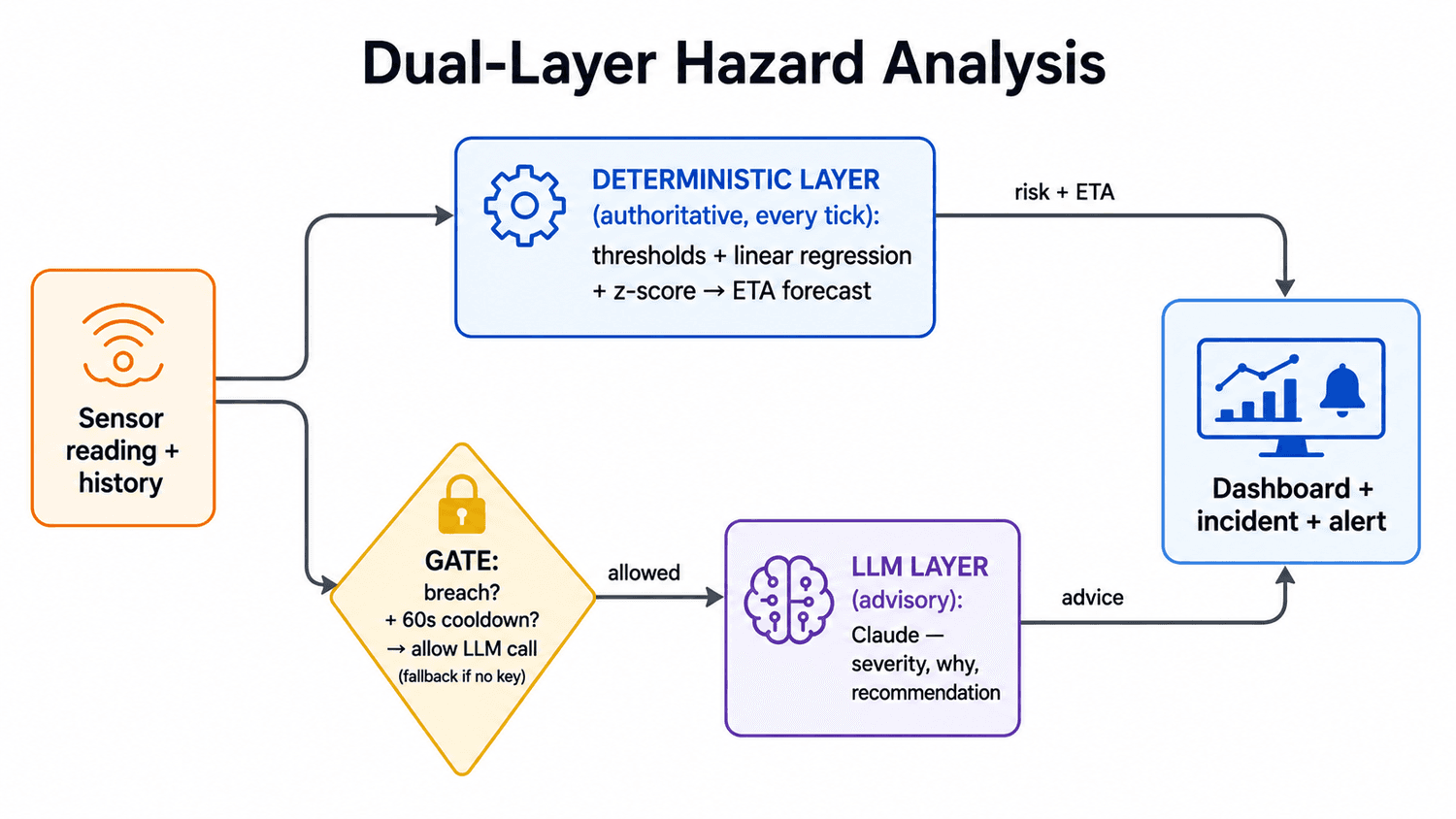
What should not be shared is the decision path. The hazard layer runs on the device, deterministically, with a bounded latency. The maintenance layer runs in the connected half, over months of history, where it can be as sophisticated as it likes because nothing waits on it.
Treated that way the two reinforce each other. Machines that are maintained fail less, and machines that fail less produce fewer of the events the hazard layer exists to catch.
What this system does today
Alfa HazardX is built for the hazard side. It carries thermal, vibration and acoustic channels alongside the gas channels, records their history, and scores movement against a per-sensor baseline.
The condition-monitoring use of that data is real but secondary: the channels are there and the history is kept, and the coarse cases - a machine trending hotter, a vibration magnitude climbing - are visible in it. Early-stage bearing diagnosis needs a spectrum at a sampling rate this node does not run continuously, and we would rather say so than imply a capability the hardware does not have.