The hazards in this environment
Every industry has a characteristic risk profile, and monitoring is only useful when it is aimed at that profile rather than at a generic list.
- Flammable solvent vapour - Decanting, mixing and cleaning operations release vapour that accumulates in still air. Many common solvents are heavier than air and pool at floor level, which is exactly where nobody mounts a detector.
- Exothermic runaway - A reaction generating heat faster than it is removed accelerates, because reaction rate rises with temperature. It is the classic self-reinforcing failure, and the window between 'warm' and 'uncontrollable' can be short.
- Toxic gas release - Carbon monoxide from combustion, and process-specific toxics. Several are odourless at concentrations already dangerous.
- Incompatible material contact - Usually a procedural failure rather than an equipment one, and typically detected by its consequences - heat, gas evolution, or both.
What to monitor
Which channels matter, and in roughly this order of usefulness for this industry.
- Temperature, and specifically its rate of change - the single most valuable channel in a reacting system
- Solvent and alcohol vapour, the closest available proxy for common process solvents
- General VOC and air quality, for broad chemical vapour presence
- Carbon monoxide and combustible gas
- Smoke, as confirmation rather than as the primary channel
Where the nodes go
Placement decides whether monitoring works. A node in the wrong place produces confident silence, which is worse than no node at all because it is trusted.
- Near reaction vessels, positioned to see the vessel's ambient rather than its surface
- At low level near decanting and drum-storage areas, where heavier-than-air vapour collects
- In solvent stores, which are often the highest-concentration space in a plant and the least frequently entered
- Away from ventilation intakes, where constant airflow suppresses exactly the accumulation you are trying to detect
What prediction adds here
This is the industry where time-to-threshold earns its place. A temperature trend on a reacting vessel is meaningful precisely because the underlying physics is a rate that increases with temperature - so a rising rate of rise is a genuine early signal rather than a statistical artefact. Baseline deviation is similarly useful: a batch that is running differently from the last fifty batches is worth a look before anything crosses a limit.
What Alfa HazardX covers today
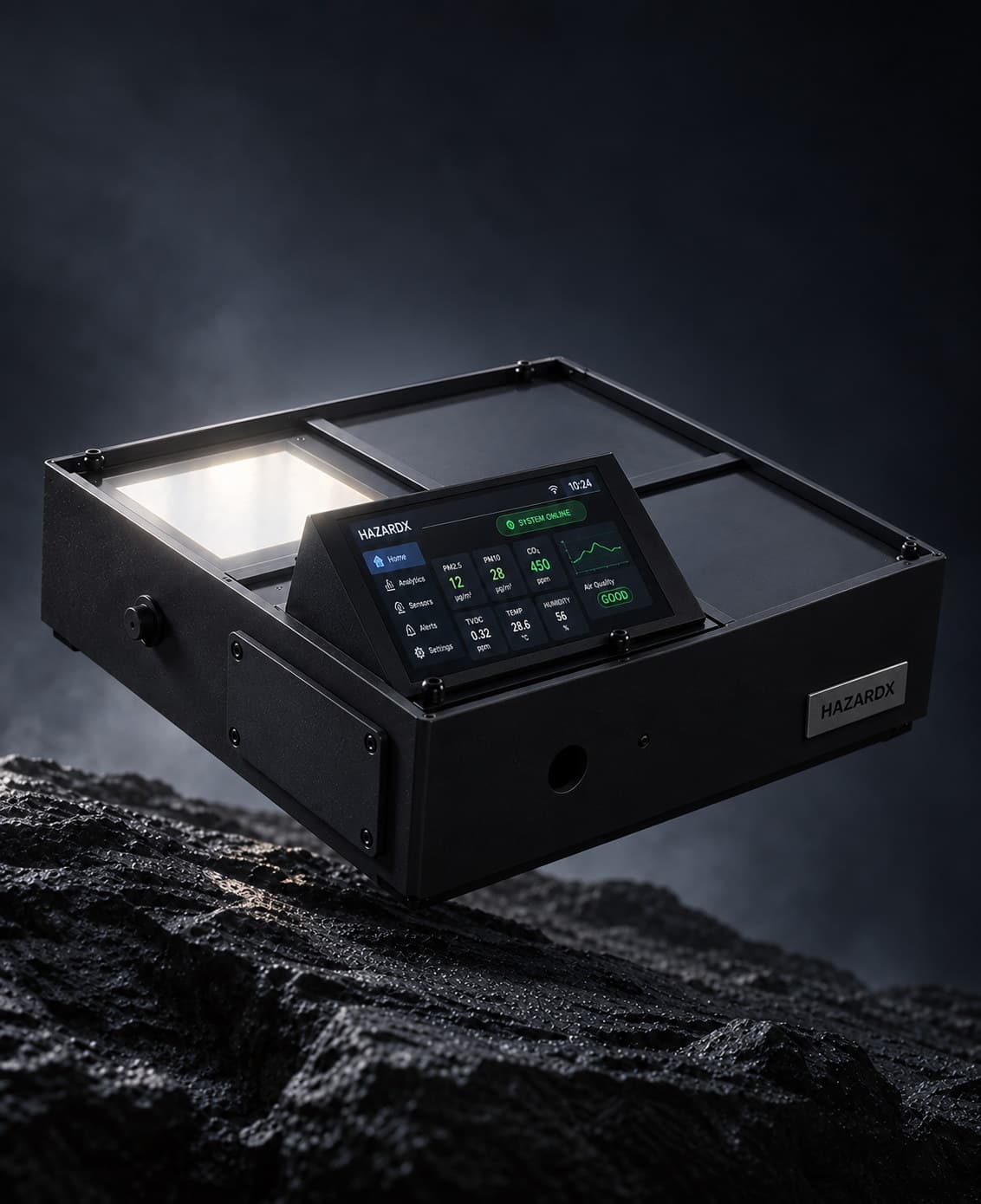
Alfa HazardX covers the thermal and vapour channels described above, fuses them into one risk state, alarms locally, and can forecast time to threshold on temperature and gas channels. Readings persist for after-the-fact review of what a batch actually did.