The problem
A gas leak is the hazard where the gap between detection and ignition is measured in seconds to minutes, and it is also the hazard most small plants monitor worst. What is typically installed is one or two point detectors on a fixed threshold, sited where the pipework is rather than where the vapour collects.
A fixed threshold has two failure modes and they pull in opposite directions. Set it low and the sensor's own drift trips it, so the alarm gets ignored and eventually silenced. Set it high and a release has to become substantial before anything happens. Neither setting tells you the difference between a leak that is growing and a reading that has crept up over six months.
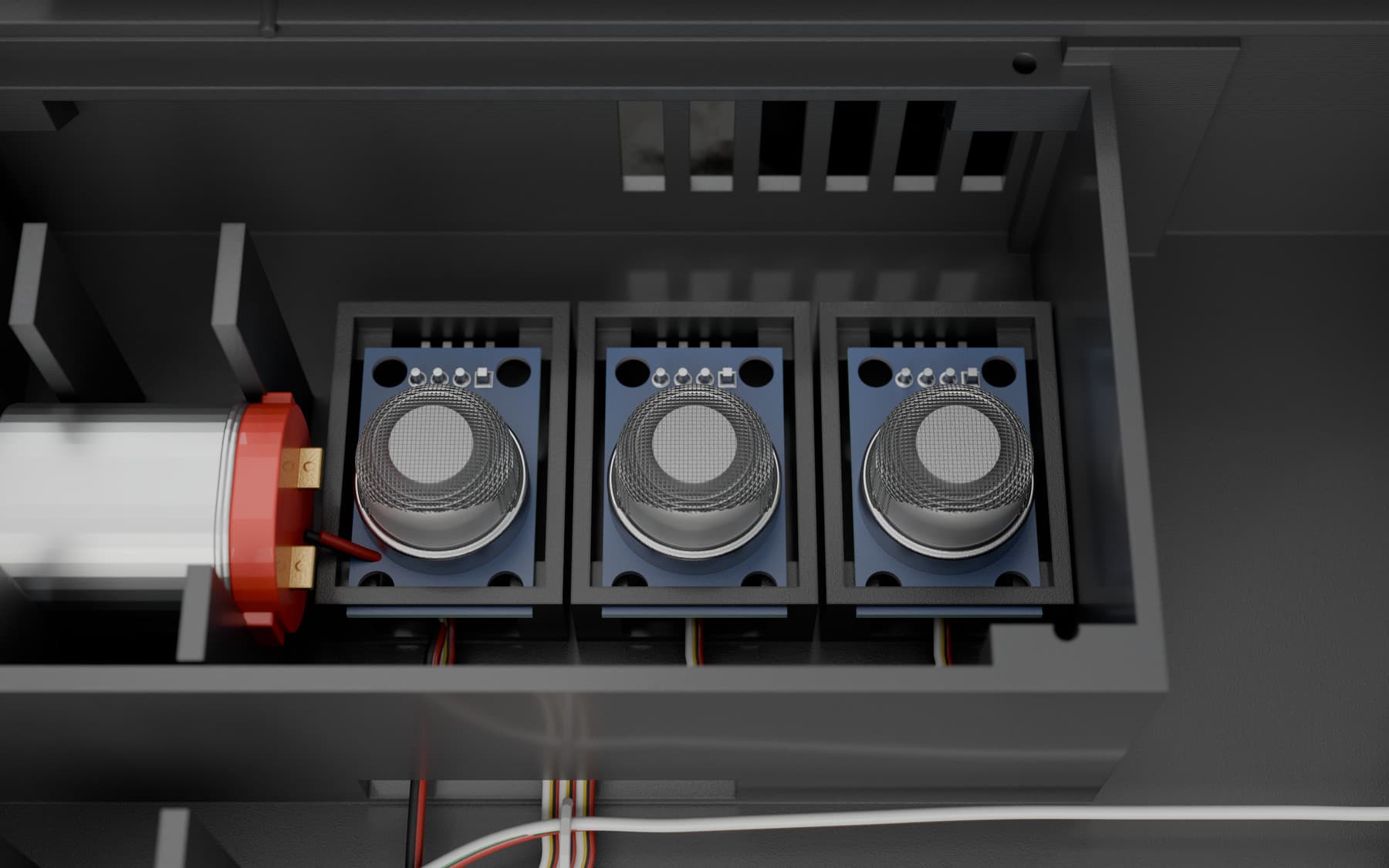
Which channels see it
Detection here is not one sensor reporting a number. It is several channels read at the same instant, where what one channel does NOT do is often as informative as what another does.
- Combustible gas — LPG, methane and smoke — the primary channel, and the one that moves first on a release.
- Air quality — Solvent and VOC load. Rises with the gas channel on a hydrocarbon release, which is corroboration; rises alone on a solvent event.
- Carbon monoxide — Separates incomplete combustion from a raw fuel release. CO moving with gas means something is burning, not just leaking.
- Ambient temperature — The negative evidence. On a gas release it does NOT move, and that absence is diagnostic.
- Barometric pressure — Catches the transient of a sudden line or vessel release.
How it is detected
The node samples every ten seconds and keeps a rolling window of the last twenty-four sample sets. From that window it computes a twelve-element vector built entirely from rates of change — velocities and accelerations, not absolute values. A sensor that has drifted upward over months has a high reading and a near-zero velocity, so it does not look like a leak. A real release has a characteristic acceleration, so it does.
That vector is matched against the site's labelled signature library by cosine similarity, behind a minimum-activity gate so a quiet room cannot match anything. The recognised signature for a combustible release is the one with a rising gas channel and flat thermal channels — the absent heat is part of the identification, not a missing piece of it.
Thresholds run in parallel and independently. The rate-of-change layer is what makes the alarm early and specific; the threshold layer is what makes it unconditional. Both run on the node itself, so neither depends on the network being up.
What an operator gets
The output is meant to be actionable by somebody on shift, not interpreted by an engineer afterwards.
- An on-device alarm — buzzer and display — that sounds whether or not the network is working.
- A bearing to the source, if the rotating head is fitted: the node steps through six headings and reports the direction the concentration peaked in, with a confidence derived from how prominent that peak was against the sweep floor.
- A forecast of which named plant assets the release reaches, and roughly when, rather than a concentration figure somebody still has to interpret.
- A recorded episode with every channel at one-second resolution for the burst, so the event can be reconstructed afterwards.