
Documentation

Everything needed to wire a node, flash the firmware, push readings and read them back out again — sensor reference, data schema, REST API and troubleshooting.

What this platform monitors

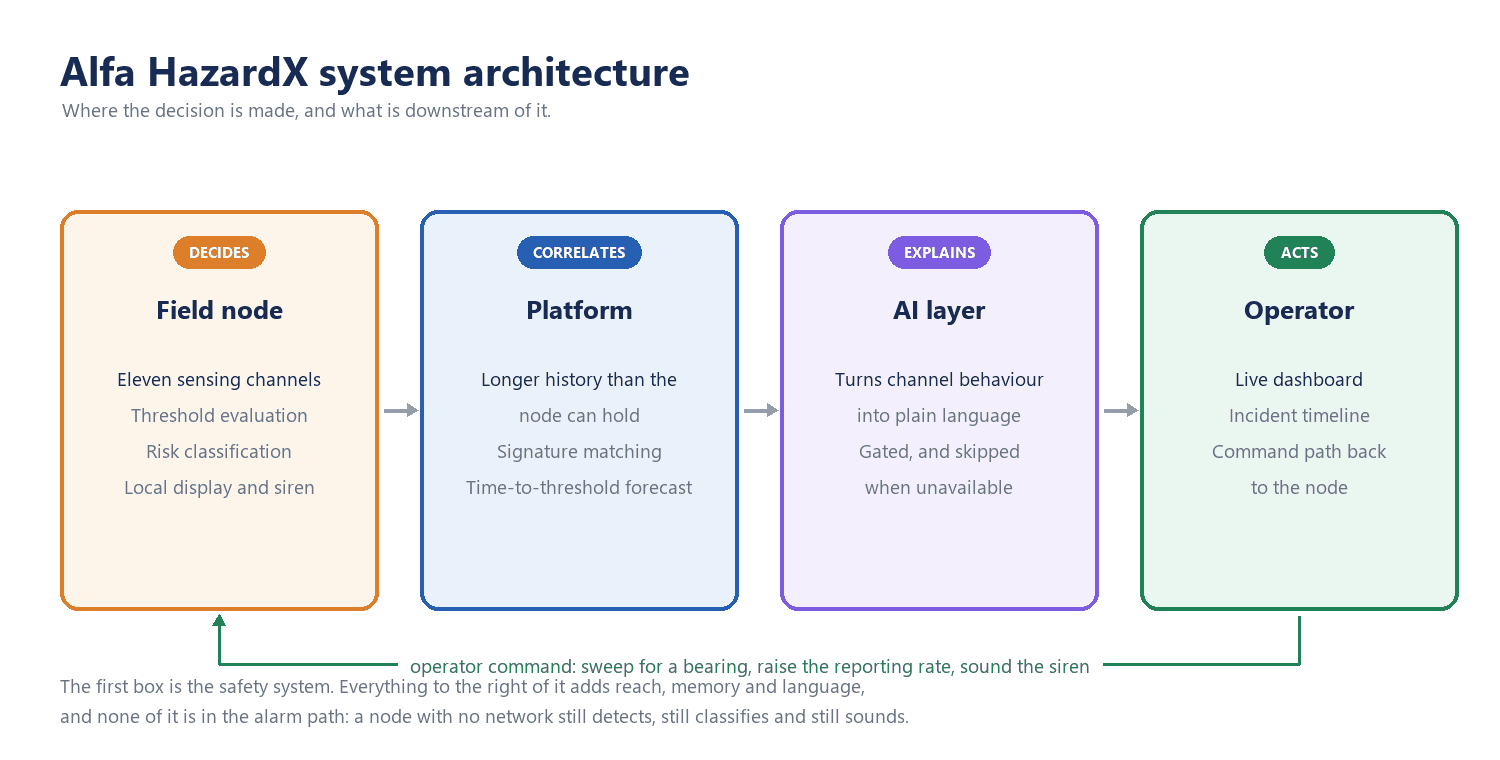
Alfa HazardX ingests telemetry from field nodes monitoring industrial environments. Each node reports eleven channels — combustible gas, carbon monoxide, general air quality, air temperature, humidity, barometric pressure, surface temperature, flame, vibration, sound and a camera frame — as one reading every ten seconds. The node sounds its own alarm on a critical value before it publishes anything; the platform then stores the reading, judges how the channels are moving, and pushes the result to every subscribed dashboard in real time.
System architecture

Alfa HazardX system architecture: the field node decides - eleven sensing channels, threshold evaluation, risk classification and the local siren - then the platform correlates against a longer history, the AI layer explains in plain language, and the operator acts, with a command path back to the node.
End-to-end: field node → platform → behaviour recognition and thresholds → real-time dashboard. The alarm path is complete before the first arrow.

How a hazard becomes an incident

Every reading is compared with the last ten minutes of readings from the same node. The platform extracts how each channel is moving and matches that behaviour against the factory's library of known hazard signatures (Hazard DNA). A strong match, or any channel past its critical threshold, raises the reading to HIGH: an incident and an alert are opened, the node is asked to sweep its sensing head to find the bearing, and it records a one-second forensic replay for the next five minutes.

Context data-flow (DFD level 0)

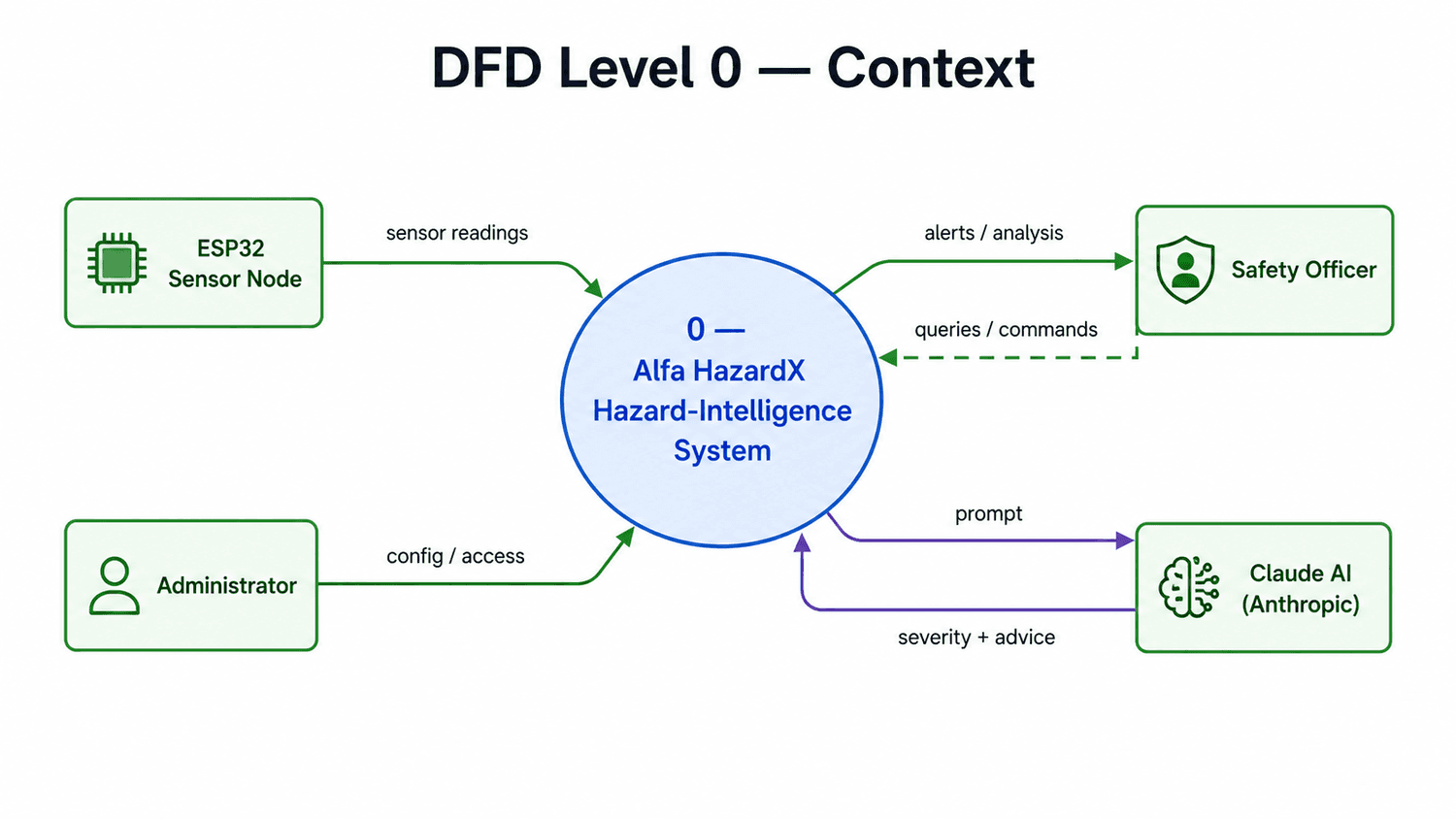
Alfa HazardX data-flow diagram level 0 — the hazard-intelligence system exchanging sensor readings, alerts, configuration and analysis with the field node, the safety officer, the administrator and the advisory layer.
Level-0 context diagram: how the system exchanges data with field nodes, safety officers, administrators and the AI assistant.