The hazards in this environment
Every industry has a characteristic risk profile, and monitoring is only useful when it is aimed at that profile rather than at a generic list.
- Flammable atmosphere in spray booths - A booth in use contains atomised solvent by design. Safety depends entirely on extraction keeping concentration below the lower flammable limit, so extraction failure is the hazard rather than the spraying.
- Mixing and decanting vapour - Mixing rooms see high concentrations in a smaller volume with typically less extraction than the booth, and are occupied by people doing manual work.
- Solvent storage - The largest quantity of flammable liquid on site, usually in the least-visited room.
- Drying and curing ovens - Heat plus residual solvent. Vapour concentration inside an oven can rise as coating cures, and an oven is a confined heated volume by definition.
What to monitor
Which channels matter, and in roughly this order of usefulness for this industry.
- Solvent and alcohol vapour - the primary channel for this industry, not a secondary one
- General VOC, for cross-checking against the solvent channel
- Temperature near ovens and curing areas
- Smoke, for ignition confirmation
- Vibration on extraction fans - a failing extraction fan is the precursor to the actual hazard
Where the nodes go
Placement decides whether monitoring works. A node in the wrong place produces confident silence, which is worse than no node at all because it is trusted.
- In mixing rooms, at working height where people are
- In solvent stores, low, because most coating solvents are heavier than air
- Adjacent to booths rather than inside them - see the limitations below
- Near extraction plant, where a fan bearing beginning to fail is visible as a vibration change
What prediction adds here
The most useful prediction here is not about vapour at all - it is about the extraction system. A fan whose vibration signature is drifting is a fan that will eventually stop, and the consequence of it stopping is a flammable atmosphere in an occupied space. Watching the machine that protects you is often higher-value than watching the hazard it protects you from.
What Alfa HazardX covers today
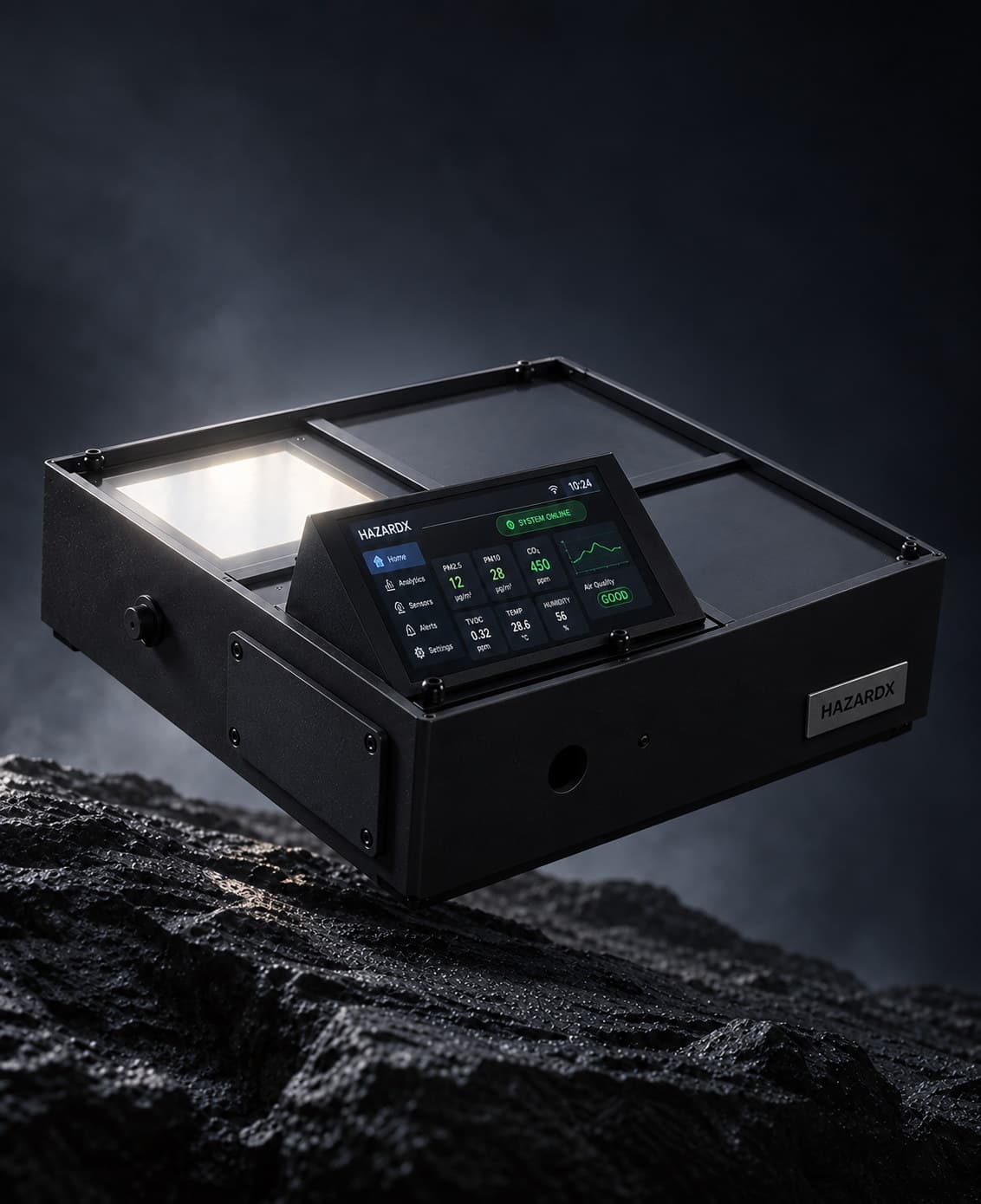
Alfa HazardX covers solvent vapour, VOC, temperature, smoke and vibration on one node, which means the fan-health and atmosphere questions are answered by the same device. Local alarm is independent of the network.