- What is Alfa HazardX?
- Alfa HazardX is a predictive industrial hazard-monitoring system that recognises a developing hazard by the behaviour of eleven sensing channels, physically rotates to find its bearing from a single fixed point, forecasts which named plant assets it will reach, and records the episode with the system's own reasoning attached.
- What hazards can Alfa HazardX monitor?
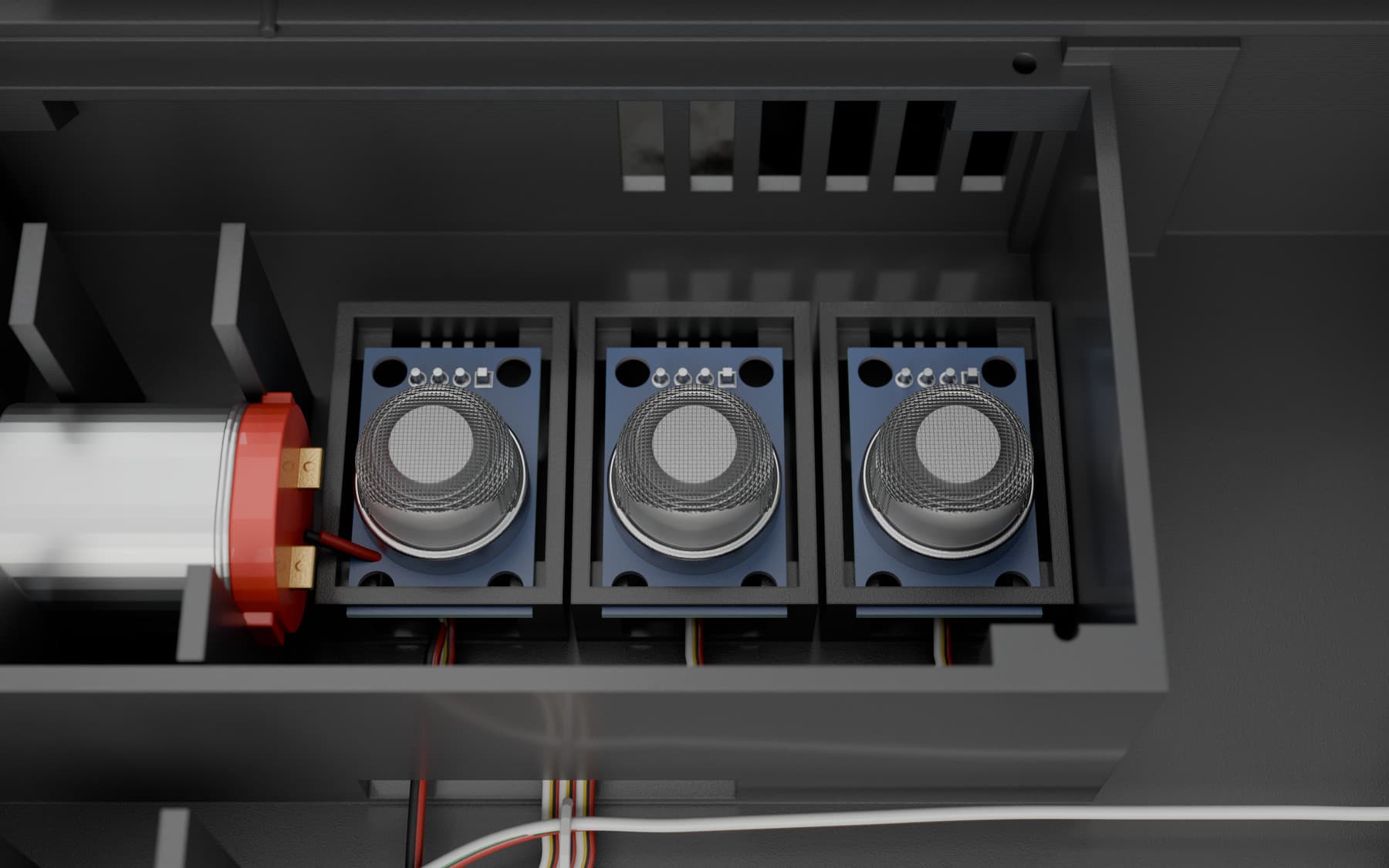
- The reference build reads eleven measurement channels from eight sensing elements: combustible gas, carbon monoxide and general air quality on dedicated gas channels, infrared flame, ambient temperature, humidity and barometric pressure from one combined module, a contact surface-temperature probe, three-axis vibration, sound level, and a camera frame. The element count and the channel count differ because one module can carry three channels.
- Does the AI control the safety response?
- No. The deterministic layer is authoritative: thresholds, risk classification and the local alarm decide the safety response. The generative model is advisory - it explains what the deterministic layer already decided and recommends a response. If the model is unavailable, unaffordable or wrong, the alarm behaviour is unchanged.
- What happens when the internet goes down?
- Detection continues. Threshold evaluation, the on-device display and the buzzer all run on the node itself, so a network outage costs dashboard visibility and AI analysis - it does not cost the alarm. Readings buffer and resend when the link returns.
- Is Alfa HazardX industrially certified?
- No. It holds no ATEX, IECEx, SIL or intrinsic-safety certification, and it should not be relied upon as a certified safety instrument or as a replacement for one. Certification is a roadmap item, not a current property. The node itself is the deployable V2 revision, built to sit alongside certified instrumentation as a monitoring and early-warning layer rather than to replace it.
- Who created Alfa HazardX?
- Alfa HazardX was founded and invented by Agresh Agrawal. The method is the subject of Indian patent application 202641098309, filed at The Patent Office, Chennai on 13 August 2026. The application was published on 21 August 2026.