The hazards in this environment
Every industry has a characteristic risk profile, and monitoring is only useful when it is aimed at that profile rather than at a generic list.
- Barrel and mould overheating - A failed heater controller or thermocouple can drive a zone well past setpoint. Polymer held above its degradation temperature evolves fumes and can char.
- Thermal degradation fumes - Different polymers produce different products when they degrade, several of them irritant or toxic. The common feature is that they appear before there is any fire.
- Hydraulic oil fires - A pinhole leak in a high-pressure hydraulic line produces an atomised mist that ignites readily against a hot surface - and machines here have plenty of hot surfaces.
- Granulator and material-handling faults - Granulators generate dust, run hard, and fail mechanically. Blocked material handling causes motors to load up and overheat.
What to monitor
Which channels matter, and in roughly this order of usefulness for this industry.
- Temperature, both ambient and rate of rise near barrels and hot runners
- VOC and general air quality - the earliest available indicator of polymer degradation
- Smoke, which arrives later than the fume channel
- Vibration, on extruders, granulators and hydraulic power packs
- Sound, as the corroborating channel for a machine under abnormal load
Where the nodes go
Placement decides whether monitoring works. A node in the wrong place produces confident silence, which is worse than no node at all because it is trusted.
- Above extruder barrels and hot-runner manifolds, out of the direct heat plume but within its ambient
- Near hydraulic power packs, where both an oil mist and a pump change would be visible
- In granulator areas, which are dusty, loud and mechanically hard-used
- In material storage and drying, where dryers run hot and unattended for long periods
What prediction adds here
This industry is where multi-channel correlation is at its most useful. A motor drawing more current runs hotter, vibrates differently and sounds different - and on an extruder that combination often means a screw or bearing problem developing over days. None of the three channels alone would justify an alarm; together they are a maintenance decision with a week of notice.
What Alfa HazardX covers today
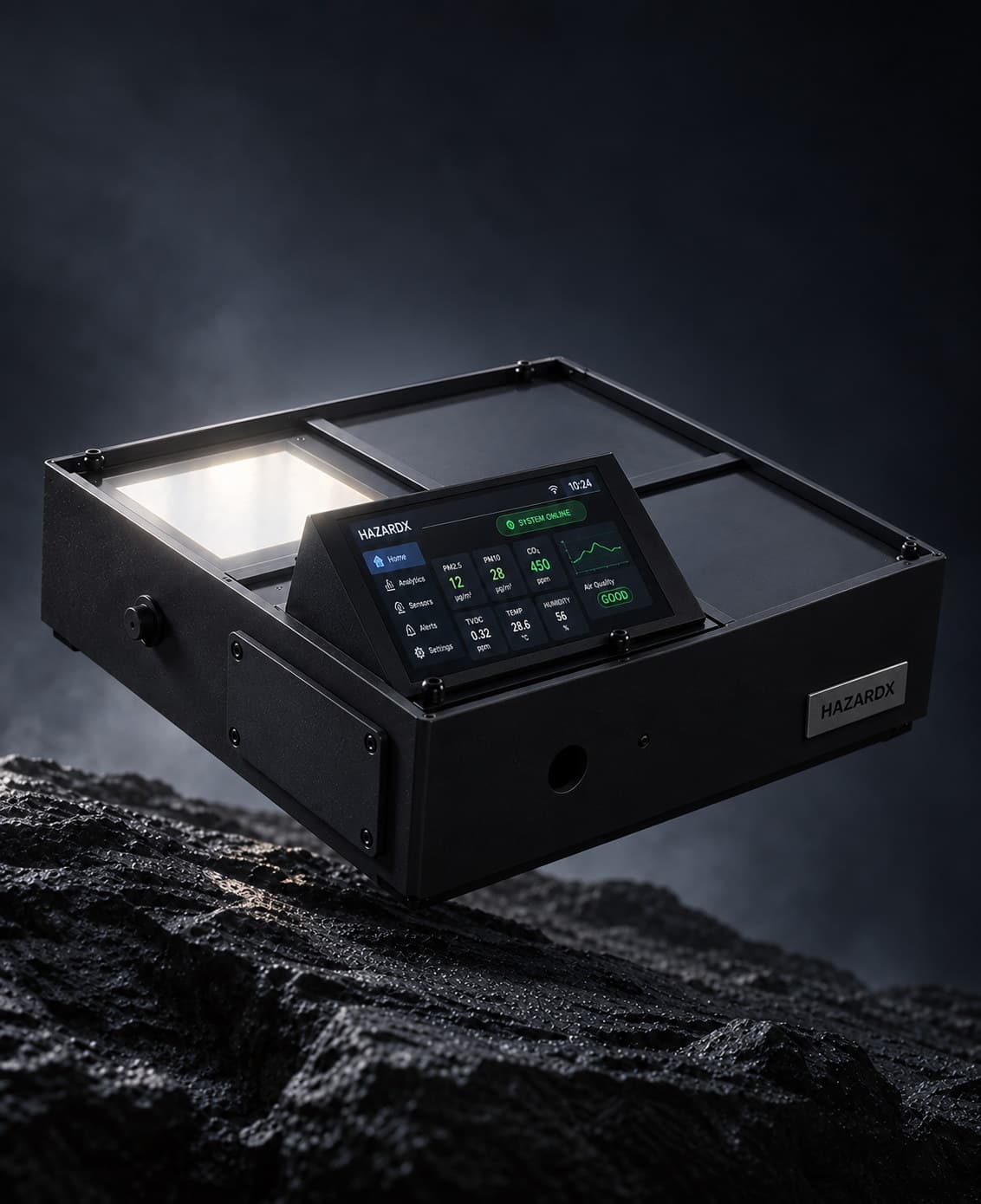
Temperature, VOC, smoke, vibration and sound on one node, fused into a single risk state, with signature matching over rates of change rather than absolute levels. That last part matters here because a machine's normal running temperature varies with the product being run.