
Traditional detection vs predictive hazard intelligence
Conventional hazard detection fires when a reading crosses a limit. Predictive hazard intelligence estimates where readings are heading and reads several channels together. Neither replaces the other: certified single-point detection remains mandatory in classified areas and is the only thing that helps with fast events, while prediction covers the gradual developments and cross-channel patterns a threshold cannot see.
Compared as categories rather than as named products. Claiming specific capabilities for a competitor’s instrument would mean either testing it or inventing the result, and only one of those is available to us.
Twelve dimensions, compared
Conventional detection wins four of these outright. That is not false modesty - it is the reason the two approaches belong together rather than in competition.
| Dimension | Conventional detection | Predictive intelligence | Stronger |
|---|---|---|---|
| Detection timing | Fires when a reading crosses a limit. By definition the hazardous condition already exists. | Estimates time to threshold from a trend, so a warning can precede the crossing on gradually developing events. | Predictive intelligence |
| Fast events | The correct and only useful mechanism. A flame or an explosion outruns any trend fit. | Contributes nothing that the threshold does not already do. Prediction needs a window of history a fast event does not provide. | Conventional detection |
| Hazard coverage | One instrument per hazard. Coverage is exactly what you paid for, and nothing else. | Several channels on one node, including combinations - heat with vibration and sound - that no single-hazard instrument reports. | Predictive intelligence |
| Abnormal-but-legal readings | Invisible. Nothing crossed a limit, so nothing happened as far as the instrument is concerned. | Detectable through baseline deviation - a value normal in absolute terms can be a large deviation for that location. | Predictive intelligence |
| False alarms | Managed by desensitising the threshold, which necessarily moves detection later. | Corroboration between channels can suppress a lone spike - but a system with more inputs also has more ways to be wrong, and this only holds if it is tuned. | Depends on implementation |
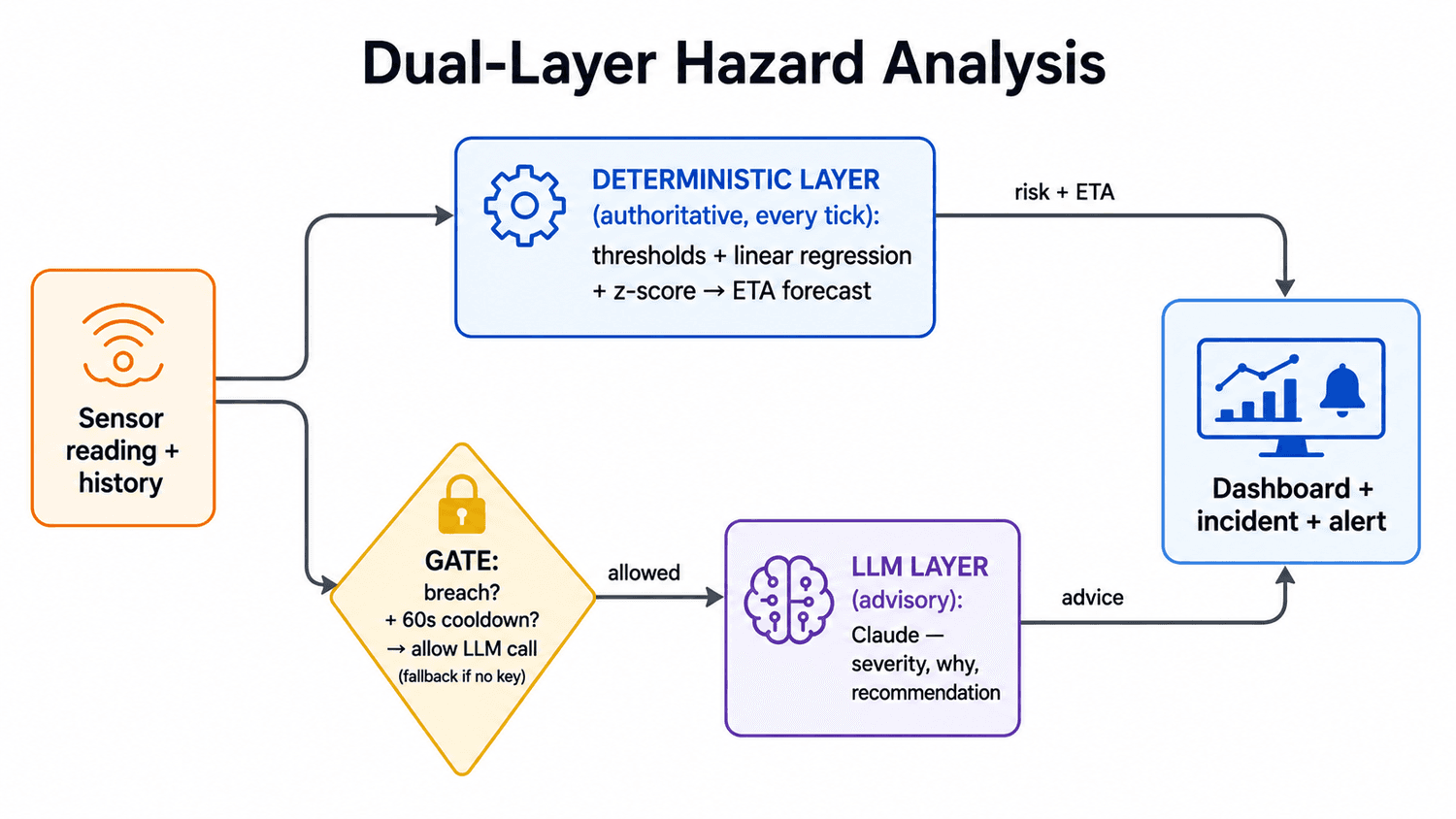
| Explainability after an incident | Excellent. A number and a constant, both readable in the datasheet. | Good where the analysis is deterministic arithmetic. Poor where a learned model is making the call - which is why the deterministic layer should hold authority. | Conventional detection |
| Certification | Mature. ATEX, IECEx, SIL and equivalent regimes exist, and in classified areas a certified instrument is mandatory. | Emerging and largely absent. Most predictive systems, including Alfa HazardX, hold no such certification and cannot substitute for one. | Conventional detection |
| Calibration | Traceable calibration against reference gas, on a documented schedule - which is what makes a reading admissible for compliance. | Often self-calibrated against ambient. Useful for trend, not for a compliance figure. | Conventional detection |
| Cost per hazard covered | High. Eleven hazards means eleven instruments plus wiring and eleven calibration regimes. | Low. The intelligence is in software, so additional channels cost a sensing element rather than an instrument. | Predictive intelligence |
| Network dependence | Typically none - a standalone detector alarms locally by design. | Varies enormously, and this is the question to ask. A system that decides in the cloud inherits every outage as a safety failure. | Depends on implementation |
| Record and investigation | Usually a panel log of alarms - the events, not the conditions leading to them. | Continuous storage of every reading, so an incident can be reconstructed rather than inferred. | Predictive intelligence |
| Maintenance insight | None. A gas detector reports gas, not the condition of the machine producing it. | Substantial as a by-product - the same heat, vibration and sound channels that detect hazards also describe machine condition. | Predictive intelligence |
How to choose
If your area is a classified hazardous zone, or a reading has to stand up as a compliance measurement, the question is settled: you need certified, traceably calibrated instrumentation, and a predictive system is at best something you add alongside it.
If your hazards are real but your plant has one smoke detector and a fire extinguisher because certified instrumentation was never affordable, the comparison is not between two systems - it is between broad monitoring and none. That is the gap predictive multi-sensor systems exist to fill, and it is where most small and mid-sized manufacturing sits.
And if you already have certified detection, the useful question is what it cannot tell you: whether a machine is degrading, whether conditions are drifting from normal, and what was happening in the twenty minutes before an alarm. Those are complements, not replacements.
Where Alfa HazardX sits
In the predictive column, with no certification and self-calibrated gas figures. It is not a replacement for certified detection and must not be installed in a classified area. Everything it does well and everything it does not is set out on the current status page.